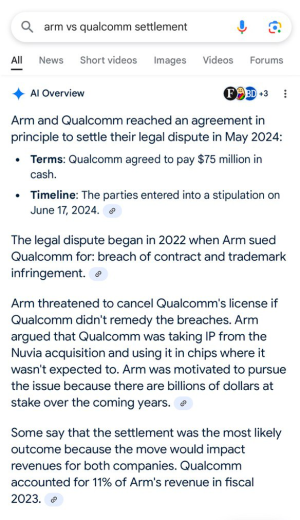
Time has flown by. Thank you for making a dedicated thread. I saw a CNBC story pop up in my feed and completely forgot this is the week.
I haven’t read the latest documents yet, as I thought there were some (Court-ordered) settlement negotiations, but those fell through. And, definitely do not trust Google’s AI Overview. It fabricated a fake settlement sometime back in May 2024?!
From the CNBC story:
Opening arguments have begun. Arm CEO Rene Haas may testify on Monday or Tuesday; Qualcomm’s CEO Cristiano Amon may testify on Wednesday. Some predictions (settlement, revenue hits, etc.) but hard to tell what is fair and what is unfounded.
From the Reuters story: https://www.reuters.com/legal/arm-qualcomm-trial-set-begin-over-chip-contract-dispute-2024-12-16/
From Court Listener (holy wow, tons of updates): https://www.courtlistener.com/docket/64938776/arm-ltd-v-qualcomm-inc/
The reddit thread above covers much of it. Some other juicy things I’ve found:
– QC may be deposing another senior Arm engineer, Jeff Defilippi
– I honestly don’t know how a jury is expected to understand all these records in the scant 11 hours per side.
– The Judge also ruled on Limine Motions (to exclude certain evidence): rulings seem to split evenly, perhaps a slight edge to Arm (e.g., Arm was able to exclude one more motion’s worth of evidence vs Qualcomm)
I think you’ve got it right. The only two other things re: NUVIA’s ALA are noted in Arm’s Reply to Qualcomm’s Defence: https://storage.courtlistener.com/recap/gov.uscourts.ded.79892/gov.uscourts.ded.79892.21.0.pdf
At a minimum (even if everything else was hunky dory between Qualcomm & Arm), Arm alleges Qualcomm still breached the NUVIA ALA by not abiding by its change of control provisions, para 226, and that consent was required:
ARM Claim: “Qualcomm acquired Nuvia even though the Nuvia ALA required Arm’s consent prior to any assignment of the Nuvia ALA, which the ALA defined to include any other company’s acquisition of Nuvia, and Arm did not consent to the assignment.”
Qualcomm says consent was not necessary, but they did apply for it nonetheless / anyways. Arm says because Qualcomm applied for it, that counts as an admission that they knew consent was required. Arm also notes in the same document that “derivatives” are included, so is Oryon a derivative of Phoenix (first blush might be yes, but the devil is in the details) or is Oryon different enough to not be a derivative?
ARM Claim: “First, pursuant to an express, independent obligation under Nuvia’s ALA, the relevant Nuvia technology, including the Phoenix core, can no longer be used and must be destroyed. This destruction obligation extends to all derivatives or embodiments of Arm technology generated at Nuvia based on Nuvia’s ALA. The Nuvia ALA leaves no doubt that the destruction obligation extends to processor cores, such as Nuvia’s Phoenix core, which is the basis for Qualcomm’s proposed future products. Defendants must discontinue any use of products derived from or embodying technology provided by Arm under the Nuvia ALA.”
Thus, I think how Qualcomm used / managed the NUVIA ALA requirements vs Arm’s understanding of the NUVIA ALA will still be important.